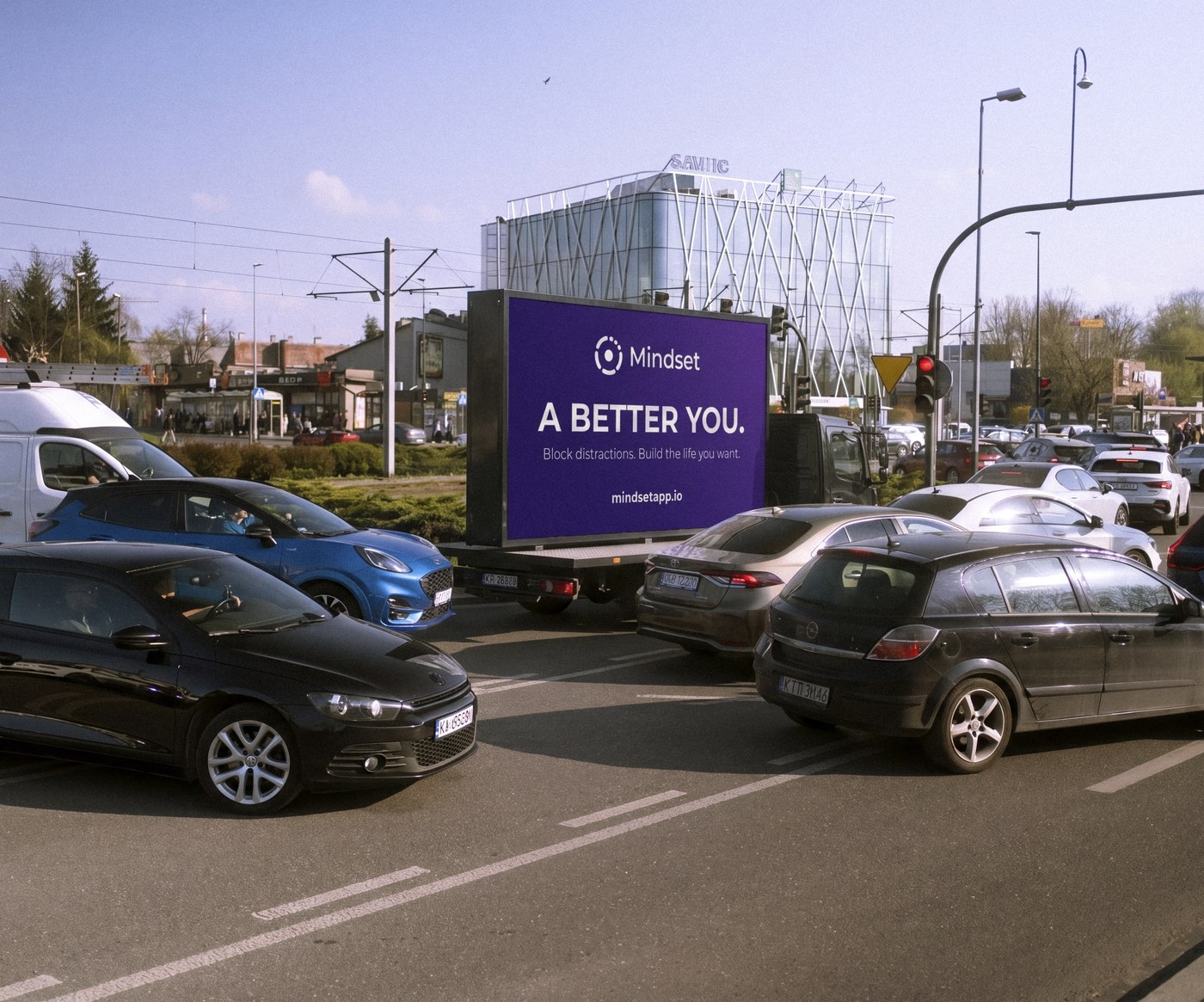
A truck rolls through midday traffic in Poznań. On its side: a large purple billboard. A Better You. Block distractions. Build the life you want. The cars around it are stopped at a red light. Their drivers are, in all likelihood, on their phones.
The irony is not lost. But neither is the truth the billboard is pointing at. The gap between wanting a better version of yourself and becoming one is not a gap of desire. Motivation is not the missing ingredient. The science says so, clearly, repeatedly, and across decades of research.
The Motivation Trap
Every productivity app ever built has started from the same premise: that you want to do better, and that if we just remind you of that, track your progress, and reward your streaks, you will. The premise is appealing because it respects your autonomy. It says: you are capable of this, you just need encouragement.
The problem is that this premise is neurologically wrong.
Motivation — the conscious desire to behave differently — operates in the prefrontal cortex. It is top-down, deliberate, and metabolically expensive. Habits, reflexes, and environmental responses operate in the basal ganglia and amygdala. They are fast, automatic, and energetically cheap. In any conflict between the two, the subcortical system wins the majority of encounters — not because the person lacks will, but because the brain conserves resources by defaulting to automation.
What Goleman's Research Shows
In Focus, Goleman describes what he calls the "constant tension" between the top-down and bottom-up attention systems. The prefrontal cortex tries to maintain goal-directed attention. The amygdala and associated systems keep redirecting it toward whatever is novel, social, or emotionally salient.
"Full focus gives us a potential doorway into flow. But when we choose to focus on one thing and ignore the rest, we surface a constant tension — usually invisible — between a great neural divide, where the top of the brain tussles with the bottom." — Daniel Goleman, Focus
Goleman does not say you can win this tension by wanting it harder. He says it requires removing the source of bottom-up interference — or training the prefrontal cortex so thoroughly that the competition is genuinely one-sided. The latter takes years of dedicated practice, available to monks and elite athletes. The former is available to anyone with the right system.
Environmental Design Is Not a Shortcut — It's the Science
The most robust finding in behavioural science over the past 40 years is this: behaviour is primarily determined by the environment, not by intention. This is not a pessimistic claim. It is an actionable one.
If you want to eat less junk food, don't buy it. Not "buy it and resist it." Don't bring it into the environment. If you want to exercise, sleep in your gym clothes. Remove the friction between cue and desired behaviour. Raise the friction on undesired behaviour until the cost exceeds the automatic benefit.
The same principle governs digital behaviour. If the phone is accessible, the habit loop will find a way to complete. Studies from Adrian Ward at the University of Texas found that the mere presence of a smartphone reduces available cognitive capacity — even when the phone is face-down, turned off, in a bag. The brain allocates inhibition resources to not-checking. The device drains you just by existing within reach.
Enforcement Is Environmental Design at the Device Level
This is what Mindset does, and why its approach is not a product choice but a scientific position. When enforcement is active, distraction is not made harder. It is made structurally impossible. The trigger fires. The app opens. The block screen appears. There is no decision to make, no willpower to spend, no motivation required.
The prefrontal cortex — freed from the task of suppressing phone-checking impulses — has its full capacity available for the work in front of it. This is not a marginal improvement. Research from Goleman and others suggests that the difference between a divided and an undivided attentional state is the difference between competent performance and genuine excellence. Flow — the state of peak cognitive performance described by Mihaly Csikszentmihalyi — requires uninterrupted focus. You cannot flow while managing notifications.
Better Isn't a Feeling. It's a Structure.
The billboard says "A Better You." That is not an inspirational slogan. It is a technical description. A better version of you is not one who wants more intensely to avoid distraction. It is one who has built a system where distraction is not an option.
The drivers stuck in that Poznań traffic, phones already in hand, are not making bad choices. They are executing conditioned responses in an environment that makes those responses trivially easy. The question is not whether to judge them. The question is whether to change the environment.
Enforcement is not a crutch. It is what the neuroscience has been pointing at all along.