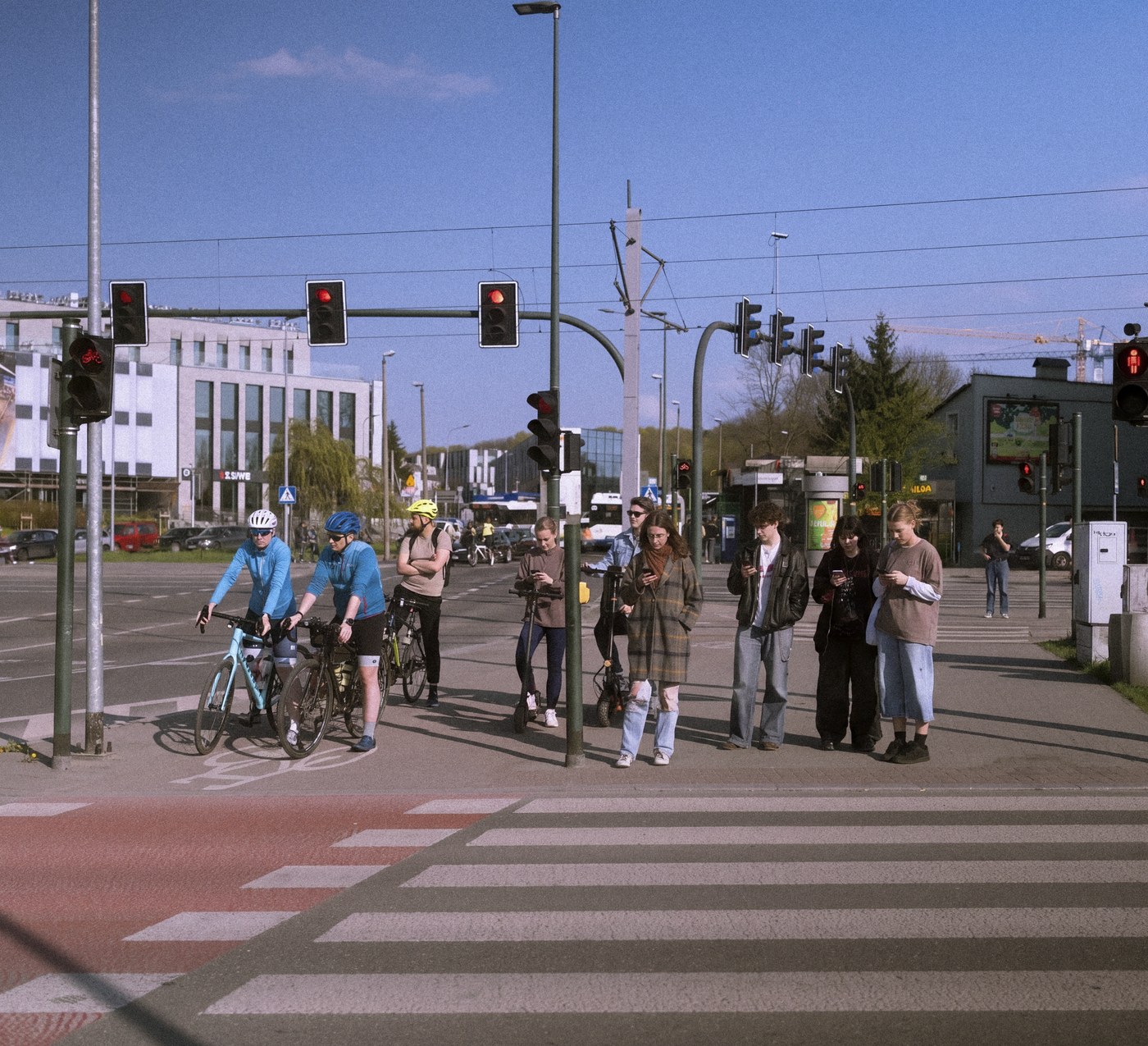
A busy intersection. Red lights. A handful of people waiting to cross — and most of them are already inside their phones. The light will change in 20 seconds. They know this. And yet the phone is already out.
This is not a small thing. This moment — the automatic phone check during any pause in forward motion — reveals something important about how the brain has been rewired over the past decade. And it tells us exactly why willpower-based solutions to phone addiction almost universally fail.
The Basal Ganglia and the Habit Loop
The brain is an efficiency machine. Every time you repeat a behaviour in response to a consistent cue, the neural pathway governing that behaviour gets transferred from the prefrontal cortex — the seat of conscious decision-making — deeper into the basal ganglia, a cluster of structures near the brain's core.
As Daniel Goleman explains in Focus: "The more we practice a routine, the more the basal ganglia take it over from other parts of the brain." Once a behaviour is encoded there, it no longer requires conscious effort or deliberate choice. It becomes automatic. It runs in the background, triggered by environmental cues, executing without your permission.
For millions of people, the cue is any moment of environmental pause. Red light. Elevator. The gap between two sentences in a meeting. Waiting for the kettle. The basal ganglia have associated each of these with a single conditioned response: check the phone.
The Habit Was Never Chosen
The troubling thing is that this habit was installed gradually and invisibly. Nobody decided "I will check my phone at every red light." The pattern assembled itself, repetition by repetition, as the brain applied its core operating principle: what fires together, wires together.
What made phones such an effective habit target is the variable reward structure they deliver. Psychologist B.F. Skinner's research — later extended into the digital realm by behavioral economists and app designers — showed that variable, unpredictable rewards produce the strongest and most resistant habit loops. You don't know if this check will bring a message, a like, a piece of news, or nothing. That uncertainty is precisely what makes the behaviour so compulsive.
The dopaminergic reward system, which signals "this was worth doing, do it again," lights up most intensely not on fixed schedules but on variable ones. Slot machines work on this principle. So do social media feeds.
"The peak of automaticity can be seen when expertise pays off in effortless attention to high demand. The way we experience this neural transfer is that we need pay less attention — and finally none — as it becomes automatic." — Daniel Goleman, Focus
Why "Just Stop" Doesn't Work
The standard prescription for phone addiction — be more intentional, set limits, use screen time reports — treats the problem as a top-down failure of self-regulation. If you just want it enough, you'll stop. But this prescription doesn't account for the architecture of the habit.
The check-at-red-light behaviour is now encoded at the basal ganglia level. It's not a decision anymore. The prefrontal cortex — the part of you that "wants to stop" — has to interrupt a subcortical process that runs automatically, at speed, in moments when conscious attentional resources are already occupied with other things.
Research on ego depletion from Roy Baumeister's lab at Florida State University found that willpower is a finite resource that depletes with use. Every time you resist picking up your phone, you spend from a limited daily budget. By the 40th red light, the budget is exhausted. The habit wins.
Environmental Design Beats Willpower
The research is conclusive: the most effective behaviour change does not rely on willpower. It relies on changing the environment so that the unwanted behaviour becomes structurally impossible, not just psychologically resisted.
Stanford behavioural scientist BJ Fogg calls this "making it hard." When the friction between cue and behaviour becomes high enough, the habit loop cannot complete. The basal ganglia trigger the response — but there is nothing to respond to. Over time, without the reward, the conditioned pathway weakens.
Mindset operates on exactly this principle. When a focus session is active, the apps that would complete your habit loop are genuinely unavailable. The cue fires. The reflex initiates. The phone is opened. But the reward is not there — just a block screen. The loop breaks.
Repeat this enough times, and the basal ganglia begin to de-encode the habit. Not immediately. Not painlessly. But structurally. The red light stops being a phone-check cue. The pause stops triggering the reflex. The automatic pilot rewrites itself — because the environment it was built for no longer exists.
The Crosswalk Is a Test
Look at that photograph again. The people checking their phones at the crosswalk are not failing a character test. They are responding exactly as their conditioned nervous systems tell them to respond. The habit is doing its job.
The question is not whether you have the discipline to override it. The question is whether you're willing to build a system — enforced at the device level — that makes the override automatic, permanent, and effortless.
That is what Mindset does. Not willpower. Structure.